Wisconsin probation and parole programs provide structured community supervision for individuals transitioning from incarceration. These programs combine legal oversight with support services to ensure compliance with court-ordered conditions, such as reporting to supervision officers, maintaining employment, and participating in treatment programs. By enforcing rules while facilitating access to rehabilitation resources, the state reduces recidivism and promotes public safety. Probation and parole officers monitor progress closely, using evidence-based strategies to address behavioral risks and encourage responsible reintegration into society.
Community supervision in Wisconsin is designed to balance accountability. The Wisconsin Inmate Locator allows the public to access current inmate information, supporting transparency and informed decision-making. Individuals on probation or parole must adhere to release conditions, including restrictions on travel, substance use, and associations, while receiving access to vocational training, counseling, and educational opportunities. These measures create a structured pathway for rebuilding personal and professional stability, helping reduce the likelihood of reoffending. Compliance with supervision rules not only protects the community but also increases opportunities for early discharge or program completion, making probation and parole a critical component of Wisconsin’s criminal justice system.
What is Probation and Parole in Wisconsin?
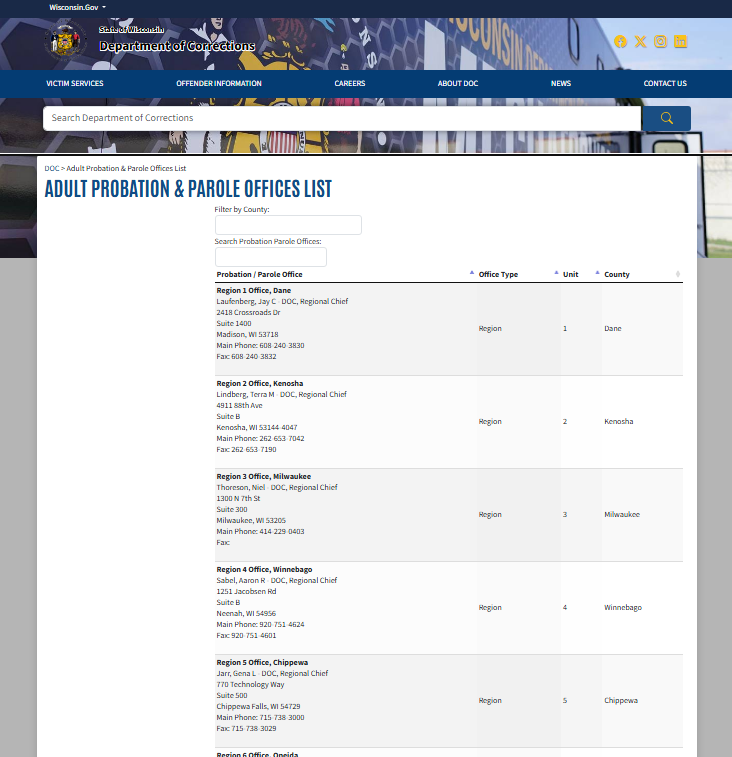
Probation and parole in Wisconsin are both forms of supervised release, but they occur at different stages of the criminal justice process. Probation is an alternative to prison, while parole allows early release from incarceration under strict supervision. The Wisconsin Department of Corrections (DOC) manages both programs, ensuring https://doc.wi.gov/Pages/AboutDOC/CommunityCorrections/ProbationParoleOfficesList.aspx that offenders follow the rules and safely reintegrate into the community. Community supervision involves monitoring, reporting requirements, and compliance with conditions set by the court or parole board. Offenders must meet certain obligations, including maintaining employment, attending counseling, and avoiding criminal activity. Release conditions and supervision rules are designed to reduce risks to the public and help offenders adjust responsibly.
Difference Between Probation and Parole
Probation occurs before or instead of imprisonment, often given to first-time or non-violent offenders. It allows them to remain in the community under supervision while serving their sentence. Parole, on the other hand, is granted after an offender serves part of a prison term, offering early release under supervision to support reintegration.
Differences include:
- Timing: Probation starts immediately after sentencing; parole follows time served in prison.
- Authority: Courts supervise probation; the DOC manages parole.
- Purpose: Probation emphasizes rehabilitation instead of jail, while parole focuses on supervised reentry.
Both programs share community supervision rules, such as regular check-ins with an officer, attending programs, and following behavioral restrictions.
Role of the Wisconsin Department of Corrections
The Wisconsin DOC oversees probation and parole offices across the state, ensuring consistent supervision and enforcement of rules. DOC staff coordinate with local courts, law enforcement, and community agencies to support offender compliance.
Responsibilities of the DOC include:
- Assigning offenders to probation or parole officers
- Monitoring adherence to release conditions
- Offering programs for substance abuse, mental health, and job skills
- Reporting violations to the courts or the parole board
The DOC’s supervision helps maintain public safety while providing structure for offenders to meet their obligations and reduce recidivism.
Community Supervision
Community supervision is a structured program that allows offenders to serve their sentences outside prison while under monitored control. Officers conduct regular meetings, home visits, and sometimes electronic monitoring to track compliance.
The goals of community supervision include:
- Promoting accountability and positive decision-making
- Encouraging employment and education participation
- Supporting rehabilitation through counseling and treatment
- Reducing re-offense rates by addressing risky behaviors
Offenders are expected to follow a clear set of rules while reporting to their supervising officer as scheduled.
How Probation and Parole Offices are Organized
Wisconsin’s probation and parole system is structured into regional offices and units to provide clear supervision and support. Each region has a Regional Chief who oversees multiple offices and ensures consistent enforcement of release conditions. The Wisconsin Department of Corrections (DOC) divides the state into eight regions, each covering several counties. These regions coordinate probation and parole services efficiently, allowing officers to maintain regular contact with individuals under community supervision. This regional structure ensures that supervision rules and release conditions are applied fairly and consistently.
Regional Office Structure
The eight regions are numbered from Region 1 in Dane County to Region 8 in Waushara County. Each region has a main regional office, which serves as the administrative hub for all probation and parole activities in its area.
- Regional Offices: These offices manage the overall operations of units, track caseloads, and oversee supervision compliance.
- Regional Chiefs: Each regional office is led by a Regional Chief who supervises unit staff, coordinates programs, and handles complex cases. For example, Region 1 in Dane County is led by Jay C. Laufenberg, while Region 3 in Milwaukee is managed by Niel Thoreson.
- Unit Offices: Each region contains multiple units, which are smaller offices dedicated to specific counties. Units handle direct contact with individuals on probation or parole and manage day-to-day supervision.
This hierarchical setup allows the DOC to maintain close oversight while tailoring community supervision practices to local needs.
Intake Offices vs. Unit Offices
Within the regional system, intake offices and unit offices serve different purposes:
- Intake Offices: These locations process new cases for probation or parole, verify eligibility, and set initial supervision conditions. For example, Dane County has a designated intake office on Martin Luther King Junior Blvd.
- Unit Offices: After initial intake, individuals are assigned to a unit office. Unit officers manage ongoing supervision rules, conduct home visits, and provide guidance to comply with release conditions.
This distinction helps ensure that every individual receives structured support from the moment they leave incarceration until the end of their supervision period.
Regional Chiefs and Their Roles
Regional Chiefs are the leaders of each regional office. Their responsibilities include:
- Supervising unit officers and administrative staff.
- Monitoring compliance with probation and parole regulations across counties.
- Managing high-risk cases and coordinating interventions when supervision rules are violated.
- Serving as the primary point of contact for local courts and law enforcement.
Their oversight ensures that both probation and parole programs operate efficiently while protecting public safety.
How Units Serve Specific Counties
Each unit office is assigned one or more counties, ensuring that supervision and services are delivered locally.
For example:
- Region 2 includes Kenosha County, with units 215, 217, and 220 serving specific communities.
- Region 5 covers Chippewa County through Unit 509.
- Region 7 in Waukesha County operates Unit 701 and others to manage local cases.
Units provide essential services such as:
- Monitoring release conditions and adherence to supervision rules.
- Conducting regular check-ins and reporting progress to courts.
- Connecting individuals with community programs and support resources.
This county-level assignment ensures that officers maintain strong connections with local resources while delivering personalized supervision.
Wisconsin Probation and Parole Regional Offices
These offices are part of the Wisconsin Department of Corrections (DOC) Division of Community Corrections and manage probation and parole supervision throughout the state. Each region is led by a Regional Chief and includes multiple units that serve specific counties, while facilities like Lincoln Hills & Copper Lake provide structured programs for youth, working closely with community corrections to support rehabilitation, education, and safe reintegration, ensuring compliance with supervision rules and release conditions for all individuals under state oversight.
Region 1 – Dane County
Region 1 covers several south‑central Wisconsin counties and serves a large portion of individuals on probation or parole. The Regional Chief oversees field operations and coordinates with local units to enforce supervision rules and support community reintegration.
- Regional Office (Main Office)
- Address: 2418 Crossroads Dr, Suite 1400, Madison, WI 53718
- Chief: Jay C Laufenberg
- Phone: 608‑240‑3830
- Fax: 608‑240‑3832
Counties Served: Dane, Dodge, Rock, Green, Lafayette
Notable Units:
- Unit 101 – Dane County
- Unit 102 – Dane County
- Unit 103–125 – Multiple counties, local field offices
Region 2 – Kenosha County
Region 2 is focused on southeast Wisconsin and serves residents in and around Kenosha County. Staff work closely with courts and community partners to monitor compliance with probation and parole terms.
- Regional Office (Main Office)
- Address: 4911 88th Ave, Suite B, Kenosha, WI 53144
- Chief: Terra M Lindberg
- Phone: 262‑653‑7040
- Fax: 262‑653‑7190
Counties Served: Kenosha
Units:
- 215 – Kenosha
- 217, 219, 220, 225, 230 – Various local field offices in the county
Region 3 – Milwaukee County
Region 3 handles the most populous area in the state. This region has the largest group of community supervision agents and serves communities across Milwaukee County.
- Regional Office (Main Office)
- Address: 1300 N 7th St, Suite 300, Milwaukee, WI 53205
- Chief: Niel Thoreson
- Phone: 414‑229‑0403
- Fax: (varies by unit)
Counties Served: Milwaukee
Units:
- 301–337 – Multiple field offices across Milwaukee
- 320, 323, 324, 350 – Specialized units focused on specific supervision populations
Region 4 – Winnebago County
Region 4 supports supervision throughout northeast and east‑central Wisconsin with a focus on local engagement and public safety.
- Regional Office (Main Office)
- Address: 1251 Jacobsen Rd, Suite B, Neenah, WI 54956
- Chief: Aaron R Sabel
- Phone: 920‑751‑4624
- Fax: 920‑751‑4601
Counties Served: Winnebago and neighboring areas
Key Units: Includes field offices serving smaller communities, focusing on consistent supervision and compliance with release conditions.
Region 5 – Chippewa County
Region 5 provides supervision services across northwest and north‑central Wisconsin. The regional office and units support individuals in both rural and urban settings.
- Regional Office (Main Office)
- Address: 770 Technology Way, Suite 500, Chippewa Falls, WI 54729
- Chief: Gena L Jarr
- Phone: 715‑738‑3000
- Fax: 715‑738‑3029
Counties Served: Chippewa and surrounding counties
Units: Include several field offices that help monitor compliance and coach positive behavior in the community.
Region 6 – Oneida County
Region 6 covers northern Wisconsin areas, combining supervision offices with outreach to help individuals meet supervision conditions.
- Regional Office (Main Office)
- Address: 2187 N Stevens St, Suite B, Rhinelander, WI 54501
- Chief: Matthew G Stake
- Phone: 715‑365‑2587
- Fax: 715‑365‑2544
Counties Served: Oneida and nearby counties
Units: Spread throughout the region, with agents assigned to local communities to support compliance and community safety.
Region 7 – Waukesha County
Region 7 supervises individuals in the southeastern part of the state outside Milwaukee County. Offices here work with courts and local stakeholders to reinforce supervision rules.
- Regional Office (Main Office)
- Address: 2120 Pewaukee Rd, Suite 201, Waukesha, WI 53188
- Chief: Vicki M Seibel‑Garvey
- Phone: 262‑521‑5130
- Fax: 262‑548‑8697
Counties Served: Waukesha and nearby communities
Units: Multiple field offices that assist in local supervision and reporting.
Region 8 – Waushara County
Region 8 serves central and eastern Wisconsin communities with an emphasis on local case management and support for individuals on community supervision.
- Regional Office (Main Office)
- Address: 427 E Tower Drive, Suite 200, Wautoma, WI 54982
- Chief: Joseph L Packard
- Phone: 920‑787‑5500
- Fax: 920‑787‑5589
Counties Served: Waushara and surrounding counties
Units: Include field offices that provide checks and support for compliance with release conditions.
Wisconsin Probation and Parole Units by County
Probation and parole units in Wisconsin list the address and contact details for each community supervision location across the state. These units support supervision rules, release conditions, and ongoing contact for people under probation and parole. The list below organizes all Wisconsin Department of Corrections (DOC) probation and parole units by county or service area. Each entry shows the unit number, county, address, phone, and fax. This helps individuals, family members, and professionals find the right unit for community supervision needs.
Dane County Units
Dane County has multiple probation and parole units that provide supervision, guidance, and support for individuals under community supervision. These units ensure compliance with rules, help clients access local resources, and maintain consistent communication to promote successful reintegration.
| Unit | County | Address | Phone | Fax |
|---|---|---|---|---|
| Unit 101 | Dane | 3318 Latham Dr, Madison, WI 53713 | 608‑277‑2444 | 608‑277‑2455 |
| Unit 102 | Dane | 2565 E Johnson St, Madison, WI 53704 | 608‑243‑3300 | 608‑243‑3359 |
| Unit 104 | Dane | 5706 Odana Rd, 2nd Fl, Madison, WI 53719 | 608‑273‑5800 | 608‑273‑5813 |
| Unit 110 | Dane | 512 E Washington Ave, Madison, WI 53703 | 608‑266‑5579 | 608‑261‑6772 |
| Unit 112 | Dane | 5706 Odana Rd, 2nd Fl, Madison, WI 53719 | 608‑273‑5800 | 608‑273‑5813 |
| Unit 113 | Dane | 2565 E Johnson St, Madison, WI 53704 | 608‑243‑3300 | 608‑243‑3359 |
| Unit 114 | Dane | 4633 Verona Rd, Suite B, Madison, WI 53711 | 608‑224‑6310 | 608‑270‑2753 |
| Unit 120 | Dane | 7017 Raywood Rd, Madison, WI 53713 | 608‑224‑6310 | 608‑224‑6379 |
| Unit 121 | Dane | 7017 Raywood Rd, Madison, WI 53713 | 608‑224‑6310 | 608‑224‑6379 |
| Unit 123 | Dane | 3318 Latham Dr, Madison, WI 53713 | 608‑277‑2444 | 608‑277‑2455 |
| Unit 124 | Dane | 2565 E Johnson St, Madison, WI 53704 | 608‑243‑3300 | 608‑243‑3359 |
| Unit 125 | Dane | 7017 Raywood Rd, Madison, WI 53713 | 608‑224‑6310 | 608‑224‑6379 |
Rock and Surrounding Counties
Probation and parole units in Rock County and nearby areas serve several communities, offering supervision and support for those returning to society. These units also coordinate with local services to address client needs and maintain public safety.
| Unit | County | Address | Phone | Fax |
|---|---|---|---|---|
| Unit 105 | Rock | 2837 Liberty Ln, Janesville, WI 53545 | 608‑758‑6075 | 608‑758‑6089 |
| Unit 106 | Rock | 2920 Prairie Ave, Beloit, WI 53511 | 608‑364‑3040 | 608‑364‑3059 |
| Unit 117 | Rock | 2837 Liberty Ln, Janesville, WI 53545 | 608‑758‑6075 | 608‑758‑6089 |
| Unit 118 | Rock | 2920 Prairie Ave, Beloit, WI 53511 | 608‑364‑3040 | 308‑364‑3059 |
| Unit 122 | Rock | 2837 Liberty Ln, Janesville, WI 53545 | 608‑758‑6075 | 608‑758‑6089 |
Dodge County
Dodge County’s probation and parole units focus on supporting individuals in the community while enforcing court-ordered conditions. Staff work closely with clients to provide guidance, monitor progress, and connect them with resources that encourage positive outcomes.
| Unit | County | Address | Phone | Fax |
|---|---|---|---|---|
| Unit 103 | Dodge | 220 Seippel Blvd, Beaver Dam, WI 53916 | 920‑885‑2940 | 920‑885‑2943 |
| Unit 115 | Dodge | 220 Seippel Blvd, Beaver Dam, WI 53916 | 920‑885‑2940 | 920‑885‑2943 |
Green and Lafayette Counties
The units covering Green and Lafayette Counties provide supervision and assistance across rural and urban areas. They manage compliance with court directives, offer support programs, and maintain regular check-ins with clients to ensure community safety.
| Unit | County | Address | Phone | Fax |
|---|---|---|---|---|
| Unit 108 | Green | 2841 6th St, Lower Level, Monroe, WI 53566 | 608‑325‑9168 | 608‑325‑9179 |
| Unit 108 | Lafayette | 15701 County Road K, Suite 1, Darlington, WI 53530 | 608‑523‑2110 | 608‑935‑5618 |
Jefferson County
Jefferson County units monitor and assist clients on probation or parole, emphasizing both accountability and support. They collaborate with local agencies to provide resources, counseling, and guidance for successful reintegration into the community.
| Unit | County | Address | Phone | Fax |
|---|---|---|---|---|
| Unit 109 | Jefferson | 163 W Rockwell St, Jefferson, WI 53549 | 920‑674‑7840 | 920‑674‑7845 |
| Unit 111 | Jefferson | 163 W Rockwell St, Jefferson, WI 53549 | 920‑674‑7840 | 920‑674‑7845 |
Walworth and Racine Counties
Probation and parole units in Walworth and Racine Counties serve multiple communities, offering supervision, support, and resources for clients. These units coordinate efforts to balance public safety with programs that help individuals stay on track and meet court requirements.
| Unit | County | Address | Phone | Fax |
|---|---|---|---|---|
| Unit 202 | Walworth | 220 South County Rd H, Suite C, Elkhorn, WI 53121 | 262‑741‑6360 | 262‑723‑5671 |
| Unit 206 | Walworth | 220 South County Rd H, Suite C, Elkhorn, WI 53121 | 262‑741‑6360 | 262‑723‑5671 |
| Unit 209 | Racine | 9531 Rayne Rd, Suite 3, Sturtevant, WI 53177 | 262‑884‑3700 | 262‑884‑3779 |
| Unit 210 | Racine | 317 N Dodge St, Burlington, WI 53105 | 262‑767‑2060 | 262‑767‑2064 |
| Unit 211 | Racine | 9531 Rayne Rd, Suite 3, Sturtevant, WI 53177 | 262‑884‑3700 | 262‑884‑3779 |
| Unit 221 | Racine | 9531 Rayne Rd, Suite 3, Sturtevant, WI 53177 | 262‑884‑3700 | 262‑884‑3779 |
| Unit 250 | Racine | 9531 Rayne Rd, Suite 3, Sturtevant, WI 53177 | 262‑884‑3700 | 262‑884‑3779 |
| Unit 260 | Racine | 800 Center St, Room 216, Racine, WI 53403 | 262‑638‑7276 | 262‑638‑7274 |
| Unit 270 | Racine | 800 Center St, Room 216, Racine, WI 53403 | 262‑638‑7276 | 262‑638‑7274 |
| Unit 280 | Racine | 800 Center St, Room 216, Racine, WI 53404 | 262‑638‑7276 | 262‑638‑7274 |
| Unit 290 | Racine | 800 Center St, Room 216, Racine, WI 53403 | 262‑638‑7276 | 262‑638‑7274 |
Milwaukee County Units
This county has many units to support community supervision and reintegration. These units provide support that aligns with supervision rules and release conditions for parolees and probationers.
| Unit | County | Address | Phone | Fax |
|---|---|---|---|---|
| Unit 301 | Milwaukee | 819 N 6th St, Suite 120, Milwaukee, WI 53203 | 414‑220‑5260 | 414‑220‑5294 |
| Unit 302 | Milwaukee | 6645 West Mill Rd, Milwaukee, WI 53218 | 414‑353‑2030 | 414‑353‑2029 |
| Unit 303 | Milwaukee | 819 N 6th St, Milwaukee, WI 53203 | 414‑212‑3535 | 414‑212‑4937 |
| Unit 304 | Milwaukee | 3073 S Chase Ave, Bldg 42, Suite 150, Milwaukee, WI 53207 | 414‑482‑7801 | 414‑482‑7855 |
| Unit 305 | Milwaukee | 819 N 6th St, Milwaukee, WI 53203 | 414‑220‑5220 | 414‑220‑5232 |
| Unit 306 | Milwaukee | 3073 S Chase Ave, Bldg 42, Suite 150, Milwaukee, WI 53207 | 414‑482‑7801 | 414‑220‑5232 |
| Unit 307 | Milwaukee | 3073 S Chase Ave, Bldg 42, Suite 150, Milwaukee, WI 53207 | 414‑482‑7801 | 414‑482‑7855 |
| Unit 308 | Milwaukee | 819 N 6th St, Milwaukee, WI 53203 | 414‑227‑4544 | 414‑227‑4196 |
| Unit 309 | Milwaukee | 3073 S Chase Ave, Bldg 42, Suite 150, Milwaukee, WI 53207 | 414‑482‑7801 | 414‑482‑7855 |
| Unit 310 | Milwaukee | 613 N 36th St, Lower Level #103, Milwaukee, WI 53208 | 414‑229‑0600 | 414‑229‑0676 |
| Unit 311 | Milwaukee | 613 N 36th St, Lower Level #103, Milwaukee, WI 53208 | 414‑229‑0600 | (none) |
| Unit 312 | Milwaukee | 3073 S Chase Ave, Bldg 42, Suite 150, Milwaukee, WI 53204 | 414‑482‑7801 | 414‑482‑7855 |
Other Wisconsin Counties
Below is a selection of units covering the rest of Wisconsin’s counties with probation and parole services. These units support local needs for supervision and compliance with release conditions.
| Unit | County | Address | Phone | Fax |
|---|---|---|---|---|
| Unit 401 | Winnebago | 240 Ohio St, Oshkosh, WI 54902 | 920‑424‑1721 | 920‑424‑2072 |
| Unit 402 | Outagamie | 2902 N Mason St, Appleton, WI 54914 | 920‑832‑2700 | 920‑832‑2716 |
| Unit 403 | Brown | 200 N Jefferson St, Suite 328, Green Bay, WI 54301 | 920‑448‑5406 | 920‑448‑5379 |
Rules and Conditions of Community Supervision
Community supervision in Wisconsin sets clear rules and expectations for people on probation or parole. These rules protect public safety while helping individuals reintegrate into society successfully. Supervision rules are designed to balance accountability with support. When a person is released from prison on parole or sentenced to probation, they must comply with specific release conditions. These may include regularly meeting with a probation officer or parole agent, attending treatment programs, and avoiding criminal activity. Violating these rules can lead to warnings, additional restrictions, or even a return to incarceration.
Supervision Rules and Expectations
Probation and parole involve structured oversight to ensure compliance with the law. Common supervision rules include:
- Reporting to the assigned officer on scheduled dates.
- Maintaining employment or participating in educational programs.
- Abstaining from illegal drugs or alcohol.
- Staying within approved geographic areas.
- Following curfews or travel restrictions, if imposed.
These rules are designed to reduce the risk of reoffending and encourage productive community participation.
Release Conditions for Parole and Probation
Every person under supervision receives a tailored set of release conditions. These conditions may vary depending on the offense, risk level, and court order, but generally include:
- Behavioral expectations: Avoiding criminal activity and associating with prohibited individuals.
- Treatment requirements: Attending mental health counseling, substance abuse programs, or anger management classes.
- Reporting requirements: Submitting to random drug tests, maintaining accurate contact information, and attending check-ins.
- Financial obligations: Paying fines, restitution, or supervision fees as required.
Following these conditions is essential for maintaining freedom in the community and reducing the likelihood of penalties.
Probation Officer and Parole Agent Responsibilities
Probation officers and parole agents are key to successful supervision. They monitor compliance, provide support, and connect clients with community resources. Their main responsibilities include:
- Conducting regular meetings to review progress and address concerns.
- Assessing risk and recommending interventions to prevent violations.
- Offering guidance for employment, education, or treatment programs.
- Reporting any violations to the court or parole board.
These professionals work to ensure safety while helping individuals stay on a positive path.
Consequences of Violating Supervision Rules
Violations of community supervision rules can lead to serious consequences. Depending on severity, penalties may include:
- Verbal or written warnings for minor infractions.
- Increased supervision, such as more frequent check-ins or stricter curfews.
- Court hearings where judges may impose additional conditions.
- Revocation of probation or parole, leading to a return to jail or prison.
Wisconsin’s system emphasizes accountability while still offering opportunities to correct behavior before harsher penalties are applied.
Community Supervision Programs and Support Services
Wisconsin offers a range of community supervision programs to support successful reintegration. These programs address education, employment, mental health, and substance use. Examples include:
- Cognitive-behavioral therapy (CBT) for decision-making and anger management.
- Job training and placement services to help individuals gain employment.
- Substance abuse treatment programs to reduce relapse risk.
- Housing assistance programs to ensure stable living conditions.
These services complement supervision rules by addressing underlying factors that may contribute to criminal behavior. Officers often coordinate these programs to promote compliance and community safety.
How to Contact Probation and Parole Offices
Probation and parole offices in Wisconsin can be contacted directly by county or region to address supervision questions, report concerns, or coordinate release requirements. Each office provides phone numbers, fax lines, and mailing addresses, with intake offices assisting new probationers or parolees. Wisconsin’s probation and parole system is organized by regions and units, making it easier for residents to reach the office that serves their county. The Department of Corrections maintains a complete list of office locations, including main numbers, unit-specific lines, and regional chiefs. For most cases, contacting the office by phone is the fastest way to receive guidance on release conditions or supervision rules.
Finding Your Probation or Parole Office
Individuals can locate the correct office by county, region, or unit. Each region covers multiple counties, and some counties have multiple units.
Steps to find your office:
- Identify your county of residence or the county handling your supervision.
- Check the Department of Corrections list of offices for that county.
- Note the unit or regional chief responsible for your area.
- Record the main phone number and fax for quick reference.
For example, Dane County has several units, including Unit 101, 102, 104, and 110, each with its own contact numbers. Milwaukee County operates multiple units as well, with different numbers for intake, reporting, and general inquiries. Using the correct office ensures prompt response and accurate handling of community supervision matters.
Office Hours and Communication Methods
Most probation and parole offices in Wisconsin are open during standard business hours, typically Monday through Friday, 8:00 a.m. to 4:30 p.m. Some offices offer extended hours for intake or reporting appointments.
Communication tips:
- Phone contact: The main office number is usually the fastest method. Always call during business hours.
- Fax: Some documents, such as forms or reports, can be sent via fax. Check the office-specific number.
- Mail: Official correspondence or probation/parole documents can be mailed to the unit’s address.
- In-person visits: Recommended for intake meetings, reporting appointments, or questions regarding supervision rules.
Staff members are trained to handle questions about release conditions, appointment scheduling, and emergency reporting. Calling the correct unit prevents miscommunication and delays.
Contacting Intake Offices
New probationers or parolees should contact the intake office in their county as soon as possible after sentencing or release. Intake officers provide orientation, explain supervision rules, and schedule initial reporting appointments.
Points for intake contact:
- Identify the correct intake office by county or region.
- Bring all necessary paperwork, including court orders and identification.
- Confirm appointment times and reporting requirements in advance.
- Ask about programs or conditions specific to your supervision plan.
Intake offices act as the first point of contact for establishing compliance with Wisconsin’s community supervision system. Prompt contact can prevent misunderstandings or violations.
Emergency Contacts and Reporting Requirements
Probation and parole offices maintain procedures for urgent reporting. Emergencies can include health crises, violations of release conditions, or law enforcement involvement.
Emergency contact recommendations:
- Use the main office phone if immediate attention is needed.
- Ask for on-call officers during non-business hours.
- Report any incident that could affect your supervision status.
- Follow instructions carefully to avoid technical violations.
Some counties have direct emergency lines, while others route calls through regional chiefs. Clear communication and timely reporting protect both the probationer/parolee and public safety.
FAQs About Wisconsin Probation and Parole
Wisconsin probation and parole provide structured supervision for offenders in the community or after early release from prison, helping them follow legal requirements while reintegrating safely.
What is the difference between probation and parole in Wisconsin?
Probation is a court-ordered sentence served in the community instead of prison, while parole allows early release from prison under supervision. Probation keeps offenders out of jail but requires regular reporting and compliance with rules. Parole monitors individuals after prison, ensuring they meet conditions like curfews, employment, and counseling. Both aim to reduce reoffending and maintain public safety.
How do I find my probation or parole officer?
Probation and parole officers are assigned based on the county or unit where an individual is supervised. People can contact their local office or use the Wisconsin Department of Corrections office locator tool to find officer contact information. Calling the office helps confirm assignments, schedule meetings, and clarify supervision requirements. Officers can also provide guidance on community programs or treatment resources.
What are typical release conditions under supervision?
Release conditions usually include reporting to an officer, maintaining employment or education, attending counseling or treatment programs, and avoiding criminal activity. Curfews, travel restrictions, and drug or alcohol abstinence may also apply. Conditions vary depending on the offense and risk assessment. Officers may adjust requirements to address specific needs while ensuring compliance and public safety.
How can I change my assigned unit or office?
Transfers to a different probation or parole unit are possible but require formal approval from the regional office. Individuals must discuss the request with their current officer and submit a transfer application. Approval depends on supervision capacity, risk level, and available resources. Officers coordinate to maintain continuous supervision during the transfer process.
What happens if I violate probation or parole rules?
Violating supervision rules can lead to warnings, stricter conditions, or revocation of probation or parole. Minor infractions may result in increased reporting, counseling, or curfews, while serious violations can trigger court hearings or jail time. Maintaining regular contact with an officer and following all rules helps prevent major consequences and ensures continued community supervision.